
Category: Videos
How to overcome waves of grief
How to overcome waves of grief
Grief often hits me in waves of sadness, and it can be difficult riding the waves of grief… Here’s a little technique that I found to be really useful in the grieving process.This week I have been knocked sideways by finding a “Dream Catcher” life goal planner that Claire wrote, she’d set goals for 1,5,10 &20 years hence – in career, fun, family, friends, romance, location, money and health…I never knew she’d written it…Imagine how I felt as I read it!
Here’s a coping strategy I’ve just started using, please do let me know what you think…
Transcript – 4 steps to cope with a wave of grief
We very often have these huge waves of grief that come over us in our horrible situation. What I want to address in this little video is a technique that I have used to overcome those waves of grief.
This is what happened to me this week. I was looking through some photographs and I found the little book that Claire wrote and she’s called it her dream catcher. And in her dream catcher book, she has written what will be happening to her in one year, five years, 10 years and 20 years from the day she wrote this book on the 17th of March, 2009. And she died almost to the day, four years later.
And in this book, she’d written what she wants to be doing with her career, with fun, family, friends, environment, romance, money and health. And when I read what Claire wanted to be doing in her life, what her dreams were, boy, can I tell you that thumped me in the heart. That got me. An overwhelming wave of grief hit me, even though it’s eight years ago that she died.
I want to share with you four little steps that I’ve started to use when I feel these waves of grief. Give these a go.
Step number one is to notice it’s a feeling. Wow, I’ve had a feeling. Notice it’s a feeling.
Step number two, this is the tricky one. Don’t label the feeling. When we label things of “oh, that was grief” or “oh, that was a bad one” or “that was something else”. That’s when we go off on a story. We label it as something and then we say, “Oh yeah, well when I’ve experienced that, I should be doing this or feeling this and that’s not fair.” And we’re off, we’re off on a story. And all of that happens in our head. If we just feel it and do not label it, don’t label it. It’s a feeling, that’s it? That’s where it stops. No labeling, no stories. It’s a feeling.
Step 3 is to self sooth. If we’d experienced this and we were telling a friend how horrible this wave of grief was, they probably put their arms around us and laid to soothe us and we can do the same. And we can say to ourselves, “That is horrible. It’s horrible you have to go through that. That’s so unfair that you have to go through that. What a horrible thing to have to go through. You poor thing.” And self sooth because it’s important that we can do that for ourselves.
And step 4 is to notice that we’re suffering and that suffering is a human condition and it’s the one thing that draws all humans together. And because we’ve not labeled our suffering, we’ve just noticed it’s a feeling, we’re not comparing it with anybody else because that will be a label and then we’re often a story. We’re not judging it against anybody else because that will be a label and then we’re often a story. We’re just noticing it’s a feeling, we’re self soothing and we’re recognizing that this is what makes us human. We are not alone. I’m not alone. This is what humans do. We suffer. And that’s a feeling and I can self sooth.
Just try those four steps the next time you have that feeling of overwhelming grief. Notice it, don’t label it, self sooth and recognize that this is what makes you human and you are not alone.
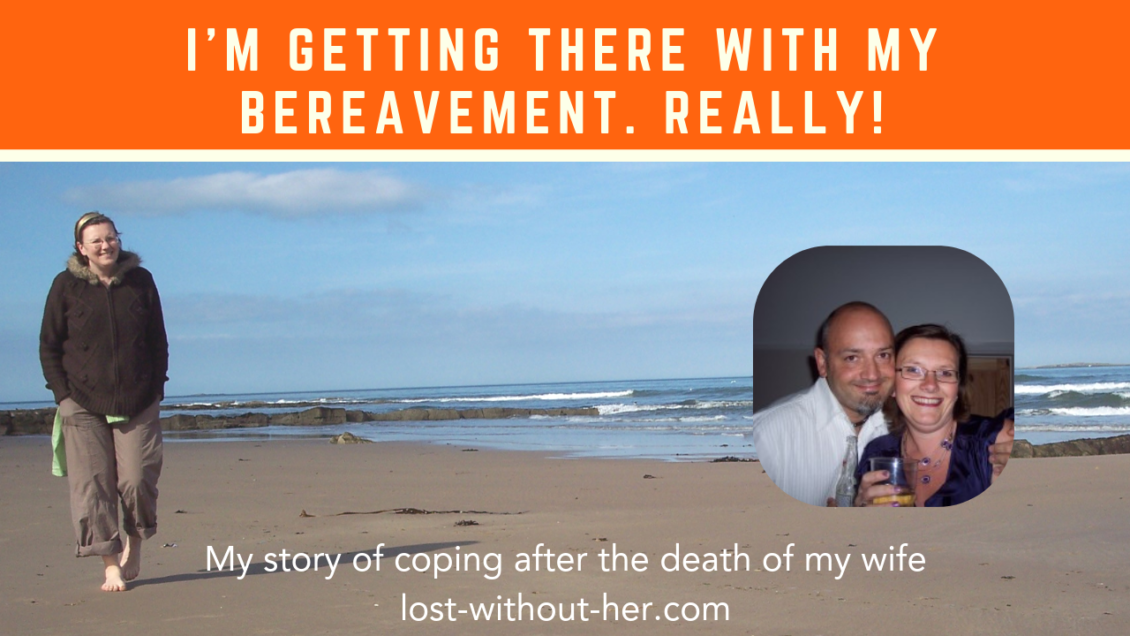
“I’m getting there!” – really?
“I’m getting there!” – really?
Do you use the phrase “I’m getting there”?
Really?
Here’s another video to challenge you!
If we’re getting there, how will we know when we are ‘there’?
What will we see, hear and feel when we are there?
And even if you knew what you will see, hear and feel to know that you have arrived ‘there’… There will be more shit to deal with once more!
Getting enough help and support is a great way for coping with bereavement. Sometimes the best way is to get self-help for dealing with grief after losing a loved one is understanding more about the strange stories we tell ourselves about the way our mind works and living truly in the now!
Bad things and good things… The balance of life?
Bad things and good things… The balance of life?
Sometimes we get a run of bad things happen to us, perhaps in a single week, month, year or even years joined together.
It seems to me that sometimes we may be able to bring balance to our lives if we write down and take note of all the good things that happen also?
Of course, this won’t take the negative away nor make those things less painful, but I just wonder… Would we feel like our life had more balance?
Climbing the mountain of grief
Climbing the mountain of grief
Sometimes, when we begin our journey into grief and loss we see the huge mountain of this life we need to live rising up in front of us… massive, craggy, insurmountable.
But if we stand there long enough, surveying the surroundings we may notice there is another way up, we reach the same destination but the journey is simpler, easier and more beautiful than we could ever have imagined.

The paradox of death and living
The paradox of death and living
When someone close to us first dies we can be lost in the depths of grief and despair and unable to think beyond the next second.
Every second is pain.
But as time goes on we find we can live two seconds before the pain hits us again, then it turns to minutes, then hours, then days.
We still think about the person we have lost 24/7 but we don’t experience that deep depth of despair every second like we used to.
And yet, the true paradox is that living second by second is truly living. If we focus on the now then nothing else matters and we are truly alive, living for the moment.
Paradoxically, that deep depth of despair, second by second living can also be a path to truly living, if we let it!
What a paradox!
Making time to grieve
Making time to grieve
Do you make time for grief? If you give yourself time and space… and by that I mean a specific time and space. I’ve found that it helps soooooo much in the grieving process!
Let me know what you think in the comments below.
Separating the emotions of the death of a loved one from the event itself
Separating the emotions of the death of a loved one from the event itself
Often, when we think about feeling happy again, after the death of a loved one it can feel almost disrespectful to their memory – here’s what worked for me.