
Year: 2021
Coping with a wedding anniversary after spouse’s death
Coping with a wedding anniversary after spouse’s death

On the day of writing this it is my wedding anniversary.
It would’ve been 30 years today, and I have to say Claire and I had genuinely a most wonderful relationship, she was most certainly taken much too young.
So the question is, how do we cope after the death of a spouse on wedding anniversaries?
It can often be really difficult because other people don’t know what to do or say so they don’t send cards.
They don’t phone as they usually would.
And it feels as though everyone else has forgotten that love and that amazing day we had – apart from me – and apart from you, of course, if you’re in the same situation.
So here’s what I do.
Focus on the now, the right now, right this instant, right this moment.
And right this moment, the sun is shining. I’ve got some beautiful scenery behind me and everything is good. The moment now only becomes ‘not good’ when I start to compare.
If I compare to the past, if I compare to what went before, if I compare to what was seemingly so unfair, then suddenly ‘now’ seems very difficult.
If I compare now to the future, to what should’ve been happening – Claire and I should be growing old together – We should be traveling the world – We should be living in the life with our camper van and our dog – Again, ‘now’ seems very difficult.
So now only becomes difficult when we compare to the past or when we compare to the future. And the thing is, the past is all in our head and it’s a story. And the future hasn’t happened yet and it’s all in our head and is a story.
So when we focus just on right this instance, right now, without comparing to the past, without comparing to the future, just what is right now, then we can have peace.
And right this instant, I’m feeling good.
Not comparing to the future, not comparing to the past, just now.
How to overcome waves of grief
How to overcome waves of grief
Grief often hits me in waves of sadness, and it can be difficult riding the waves of grief… Here’s a little technique that I found to be really useful in the grieving process.This week I have been knocked sideways by finding a “Dream Catcher” life goal planner that Claire wrote, she’d set goals for 1,5,10 &20 years hence – in career, fun, family, friends, romance, location, money and health…I never knew she’d written it…Imagine how I felt as I read it!
Here’s a coping strategy I’ve just started using, please do let me know what you think…
Transcript – 4 steps to cope with a wave of grief
We very often have these huge waves of grief that come over us in our horrible situation. What I want to address in this little video is a technique that I have used to overcome those waves of grief.
This is what happened to me this week. I was looking through some photographs and I found the little book that Claire wrote and she’s called it her dream catcher. And in her dream catcher book, she has written what will be happening to her in one year, five years, 10 years and 20 years from the day she wrote this book on the 17th of March, 2009. And she died almost to the day, four years later.
And in this book, she’d written what she wants to be doing with her career, with fun, family, friends, environment, romance, money and health. And when I read what Claire wanted to be doing in her life, what her dreams were, boy, can I tell you that thumped me in the heart. That got me. An overwhelming wave of grief hit me, even though it’s eight years ago that she died.
I want to share with you four little steps that I’ve started to use when I feel these waves of grief. Give these a go.
Step number one is to notice it’s a feeling. Wow, I’ve had a feeling. Notice it’s a feeling.
Step number two, this is the tricky one. Don’t label the feeling. When we label things of “oh, that was grief” or “oh, that was a bad one” or “that was something else”. That’s when we go off on a story. We label it as something and then we say, “Oh yeah, well when I’ve experienced that, I should be doing this or feeling this and that’s not fair.” And we’re off, we’re off on a story. And all of that happens in our head. If we just feel it and do not label it, don’t label it. It’s a feeling, that’s it? That’s where it stops. No labeling, no stories. It’s a feeling.
Step 3 is to self sooth. If we’d experienced this and we were telling a friend how horrible this wave of grief was, they probably put their arms around us and laid to soothe us and we can do the same. And we can say to ourselves, “That is horrible. It’s horrible you have to go through that. That’s so unfair that you have to go through that. What a horrible thing to have to go through. You poor thing.” And self sooth because it’s important that we can do that for ourselves.
And step 4 is to notice that we’re suffering and that suffering is a human condition and it’s the one thing that draws all humans together. And because we’ve not labeled our suffering, we’ve just noticed it’s a feeling, we’re not comparing it with anybody else because that will be a label and then we’re often a story. We’re not judging it against anybody else because that will be a label and then we’re often a story. We’re just noticing it’s a feeling, we’re self soothing and we’re recognizing that this is what makes us human. We are not alone. I’m not alone. This is what humans do. We suffer. And that’s a feeling and I can self sooth.
Just try those four steps the next time you have that feeling of overwhelming grief. Notice it, don’t label it, self sooth and recognize that this is what makes you human and you are not alone.
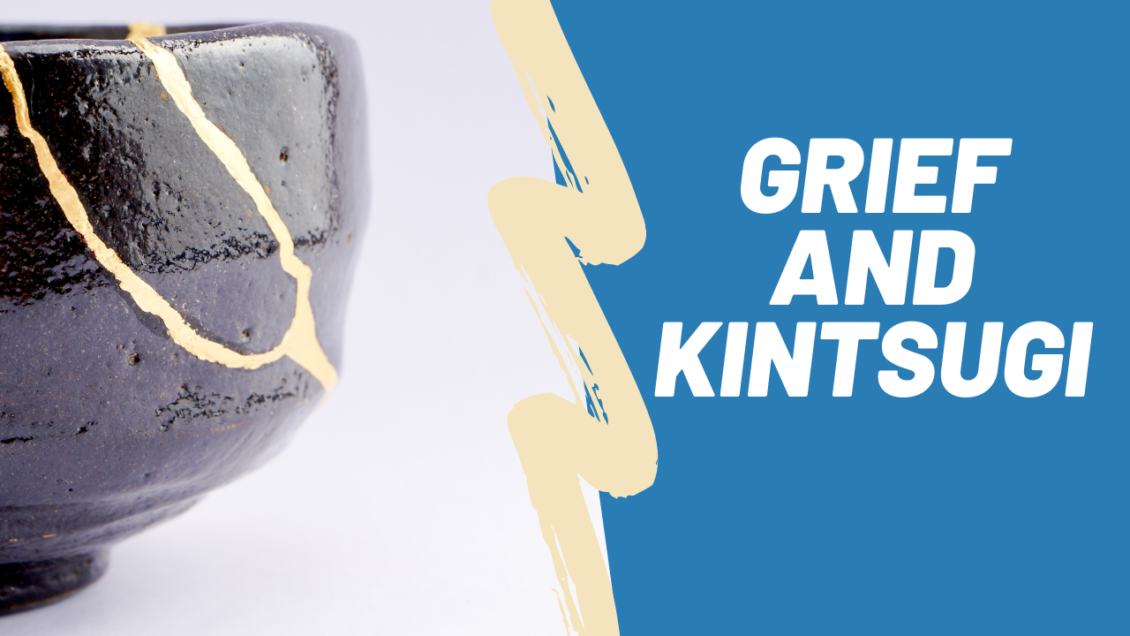
Grief and Kintsugi – Adding to The Beauty of What Was
Grief and Kintsugi – Adding to The Beauty of What Was

The Japanese art form called Kintsugi 金継ぎ “golden joinery” is the Japanese art of repairing broken pottery with lacquer that is dusted or mixed with powdered gold, silver or platinum. The artform, as a philosophy treats breakage and repair as part of the history of an object, rather than something to disguise.
It’s truly beautiful.

Kinsugi is a centuries-old art form which relies on a few guiding principles:
- Breaks and cracks should be emphasised rather than hidden or disguised.
- The repaired piece should be even more beautiful than the original.
- The repaired piece should have a second lease of life.
- The break or repair should be treated as part of the history of the object.
- Flaws and imperfections are something to be embraced.
All of this is held in perfect harmony with, and not contrary to the fact that the object was indeed beautiful in its first iteration, before it smashed.
Living with grief has many similarities.
Before Claire died I was very happy with my life, I wouldn’t want anything to change, life was beautiful with her.
And then this awful thing happened, my life was smashed apart, broken into a 1000 pieces.
I could stare at the all of those pieces and wish for that life to be reinstated. Somehow, magically those pieces should reform themselves, with no cracks, into the beautiful life it was before.
Except that will never happen.
So instead, I choose to treat the flaws and imperfections that were caused as something to be embraced. Those cracks are now part of my history, and as such add beauty.
Some people like the look of Kintsugi, some people might prefer the look of the item before. Neither are right. Neither are wrong.
Regardless of whether you like Kintsugi or not, there’s no going back. There’s no way to put things back the way they were before, so I’m moving forwards, celebrating the past and adding to it rather than taking away.
I don’t think this is a viewpoint we can clearly see immediately in the aftermath of the death of someone close to us.
It’s all too raw, too painful and we want nothing more than to have everything put back the way it was before.
I do however think there comes a point of acceptance. Acceptance of both the pain and the fact of the death.
The question then becomes, what do we do with that acceptance. Do we sit back and idly allow life to pass us by, everyday looking at the smashed pieces on the floor and wondering why we can’t put things back the way they were. Or, do we treasure all of those broken pieces and painstakingly reassemble what we can, with love, with care and by actually adding to the beauty of what was there before?